David Fischer · 25 September 2026
Regional Funding Shifts Prompt Agricultural Adaptations Across District Boundaries
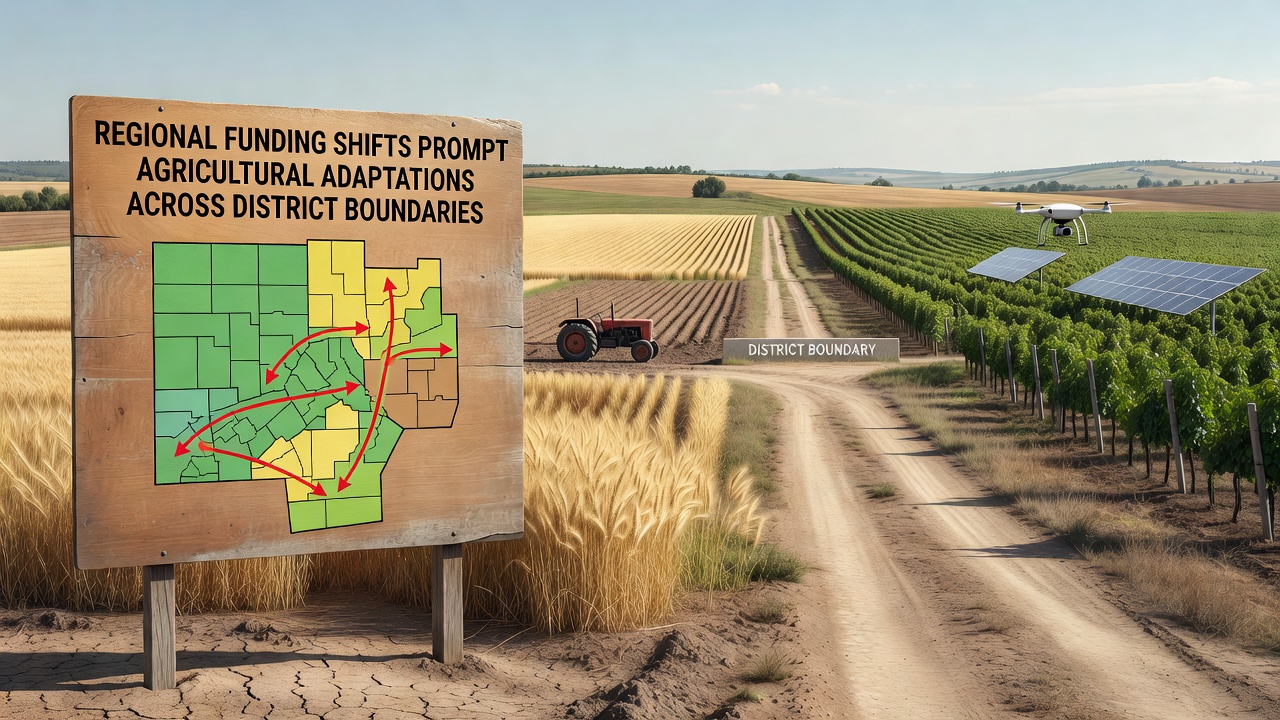
Regional funding allocations for agriculture have undergone notable changes in recent years, with adjustments announced as recently as September 2026 reshaping how farmers approach resource management and operational planning. Data from multiple government agencies shows that shifts in grant distribution and subsidy structures now encourage operations that cross traditional district lines, prompting adaptations in crop selection, equipment sharing, and water usage strategies across broader geographic areas.
Tracking the Funding Changes
Allocations from federal and state programs have moved away from fixed district-based models toward performance-linked criteria that reward efficiency and cross-boundary collaboration. Figures released by the United States Department of Agriculture in mid-2026 reveal a 14 percent increase in grants supporting multi-district initiatives compared to 2024 levels, while single-district projects saw reductions in several regions. Similar patterns appear in Australian agricultural reports, where the Department of Agriculture, Fisheries and Forestry documented rising applications for funding that require partnerships spanning local government areas. These adjustments stem from policy updates aimed at addressing climate variability and supply chain resilience, according to official program guidelines.
Farmers in affected zones have responded by forming cooperatives that pool resources from neighboring districts. One analysis of 2025-2026 application data indicates that joint submissions for irrigation upgrades rose sharply in the Great Plains and Midwest corridors, where water rights often straddle administrative boundaries. The result includes expanded use of shared sensor networks and variable-rate technology that optimizes inputs across larger tracts of land.
Adaptations Taking Shape on the Ground
Changes in funding eligibility have accelerated shifts toward drought-tolerant varieties and precision planting techniques in areas previously reliant on single-crop systems. Research compiled by the European Commission's agricultural directorate shows parallel developments in parts of southern Europe, where revised subsidy rules favor operations that demonstrate reduced water consumption through coordinated district-level planning. Growers there report increased adoption of cover cropping and soil monitoring tools funded through pooled grants that cross provincial lines.

Equipment sharing arrangements have also expanded. Districts facing tighter capital grants now coordinate purchases of high-cost machinery such as autonomous sprayers and harvesters, allowing smaller operations to access technology previously limited to larger single-district entities. Records from Canadian provincial agriculture ministries note a measurable uptick in these joint ventures since 2025, particularly in the Prairie provinces where growing seasons and soil types vary across municipal borders yet share similar climate pressures.
Cross-Boundary Effects and Emerging Patterns
Observers tracking land use patterns note that funding realignments coincide with gradual changes in planting decisions that ignore older district maps. In regions where one district received enhanced support for specialty crops while an adjacent area saw cuts to commodity programs, producers have adjusted rotations and leased parcels to capture available support. University extension services in several states have recorded higher volumes of inquiries about interstate or inter-district leasing options during the 2026 application cycle.
Water management provides another clear example. Where funding now ties to basin-wide conservation metrics rather than district-specific targets, irrigation districts have begun aligning schedules and infrastructure investments. This coordination reduces duplication and supports more consistent delivery across boundaries, according to hydrological studies released in late 2025.
Looking Ahead
Program administrators continue to refine eligibility rules based on performance data collected through 2026. Early indicators suggest further emphasis on measurable outcomes that span multiple jurisdictions, which may accelerate the trend toward collaborative models. Agricultural economists monitoring these developments point to the need for updated mapping tools and legal frameworks that accommodate fluid operational boundaries while maintaining accountability for public funds.
Continued tracking of grant distributions and adaptation metrics will clarify the long-term spatial effects of these funding shifts on production landscapes.
Conclusion
Regional funding adjustments have created conditions where agricultural practices increasingly operate beyond single-district constraints. Evidence from multiple continents shows corresponding changes in technology adoption, crop choices, and resource coordination that follow the new incentive structures. As allocation formulas evolve, the spatial organization of farming activities continues to reflect these policy signals.